Showing posts with label book review. Show all posts

Saturday, February 10, 2018

Book Review--Red Sparrow by Jason Matthews


Quite the bummer this one...

Covered with praise from numerous publications (USA Today, Washington Post, Publishers Weekly, NYT, etc.) and coming from someone within the US Intelligence community (Matthews has years of experience working in the clandestine service of the CIA) I had high hopes.

I should have realized that given Matthews was given a 7 figure advance on the book and its two sequels before a word was put down and a movie deal signed shortly thereafter for Jennifer Lawrence to star in a film trilogy based on these books that this was no serious effort but instead a pre-packaged media driven vehicle to create a new "Hunger Games" (same director even) or "Twilight" series with only pretensions of seriousness.

 Further hints of the lack of real work here comes up early on when the female protagonist, written purposefully for Jennifer Lawerence to play, is detailed to have a heretofore unknown version of synesthesia that gives her the superpower like ability to determine the character and truthfulness of another person via the colors she sees surrounding them like an aura.  Over and over and over "this person is surrounded in yellow...this one is colored in blue...this one in red..."  blah, blah, blah.  Profoundly tiring and hackneyed one comes to view the female character as one of little real talent or intelligence but merely imbued with genetic abnormality that makes her good at her particular job.

And what is her job?  Well, to even sell the film series more...she's a "Sparrow" a Russian agent trained to seduce foreign individuals with their physical wares...Insert eyeroll here...This serves only for the author to engage in his puerile sexual fixations and set up Jennifer Lawrence to parade around on film in skimpy outfits.

For those hoping to hear of true tradecraft I suppose there are nuggets here and there--the Russians using a "dust" of a kind that can then be scanned for on the personages of their own people to see if they have been in contact with other spies, etc....but mostly?  Its stuff like "He left his hotel...he didn't want to be followed....so he walked around in a random pattern for hours looking for followers..."  Great...real groundbreaking stuff.

If you want to read a trashy novel to prepare yourself to watch a trashy movie and think that you are being progressive because Putin makes multiple appearances in the novel as the ultimate bad guy string puller...this is all you...Roundfile this otherwise...

Sunday, January 17, 2016

Book Review: The Caine Mutiny

Maudlin, melodramatic, simple, cliche...all of these MIGHT be used to describe parts of The Caine Mutiny...they'd all be partly right and all be significantly wrong.

Some 500+ pages in length this Pulitzer Prize winning work is easy to read.  There are no verbal flourishes or complex structures--yet it fleshes out its characters in ways most novels only aspire to without leaving the reader wishing for plot progress.

Its supposed "main" character is Willie Keith, a young sailor who is an upperclass, spoiled, WASP from NY.  Wouk doesn't shy away from showing all the prejudices of the times (WWII era), blacks, jews, gays, Catholics, women in general, etc. are all viewed as lower than ideal--yet, this is where the book is most progressive.  It is the Jew who rescues Willie Keith and his friend, Maryk during their court martial hearings.  It is May Wynn, the poor Catholic girl, who Willie turns to and away from his WASP mother at the end of the novel.  It is the blacks who stand by and hold their positions on the ship while the white captain jumps overboard to save his precious novel.

At the time the novel was written and following very popular movie made (which I have not seen to date) WWII was only six years behind the audience in 1951.  Likely they were more thrilled with the prospect of reading about the actions on board a minesweeper in the midst of the Pacific War than they were in hearing of the social inequities and conflicts to come foreshadowed here (JFK's election as the first Catholic president, Civil Rights and Women's Rights battles to come) and if someone wants to point out instances of where these parts of the novel were brought up at the time of its publishing you can certainly do so.  To me it seems a book about 15 years ahead of its time.

That said, The Caine Mutiny is also a supremely entertaining novel.  Largely without battles or military conflict one might think of in a book occurring during WWII, the Caine (a decrepit WWI era destroyer) is relegated to menial duties--towing targets, escorting other, more important ships, etc. It is the personal conflict between the crew of the Caine (and particularly the primary protagonist, Willie Keith and his close crewmates) and its Captain Queeg, that move the story forward.  Herman Wouk's portrayal of a nit-picking, paranoid, under-educated, over-promoted captain is one so famous that the term "Captain Queeg" has become synonymous with virtually any overbearing boss, and rightly so.  I would encourage any business person to read this novel and see if they don't recognize a few Captain Queegs in their own organizations.  In fact, the novel may be an excellent educational tool for businesses in teaching management that any rigid adherence to regulation, focus on the minutia of process vs. the evidence of result can be a significant detriment to a staff and its efficiency.

Lastly, the book is a great, if brief, love story.  Largely "book-ending" the novel as it were, the romance between Willie Keith and May Wynn is far from ornamental.  As Willie grows from spoiled, ignorant, prejudiced boy to a man who can see the "grey" areas that exist in relationships and life in general, so does his relationship with May grow from careless dalliance between an immature sailor departing for war to one of respect and true love for the whole person that May represents.

Couldn't recommend this novel more highly.

Wednesday, July 8, 2015

Book Review: The Water Knife

This is the second novel I've read by Paolo Bacigalupi I've read with the first being "The Windup Girl".  Unfortunately I should have taken my feelings from that first novel and remembered them more clearly before picking up this one.

We are once again in the near future, though this time it is the very near future instead of a hundred or more years away.  While in "The Windup Girl" we were concerned with rising oceans and the absence of oil, here we are concerned with a lack of water, competing water cartels in the desert Southwest and the breakup of the United States

In both cases Bacigalupi writes in a style more attuned with his young adult novels where he got his start.  The language and rhythm of the writing is juvenile and simple.  Cormac McCarthy this is not.

Nor is this William Gibson.  The novel is almost "cute" in its portrayal of its dystopian future.  We have all the queues we see in our daily life just drawn a bit farther out--shiny Teslas, Chinese investment in American real estate, Google Glass like devices, drought ridden California and the Southwest in general, mentions of well known brands like Camelback, REI, Aquafina, etc.  Its like Bacigalupi just threw a bunch of New York Times articles in a blender and put the resulting mush on the page.  He isn't creating much or providing much insight here, he's merely regurgitating what we already know.  And that's the difference between someone like Gibson and himself.

Gibson will create things out of his own mind that do not exist yet and show you a vision of the future you hadn't thought could exist.  Bacigalupi shows you a future that's already been predicted and that you know won't happen because the world just isn't that easy to forecast.

"The Water Knife" is a good novel if you don't want to think and just want to say "Yeah!  Right on!  I think we're going to hell too!"  Sorry but I need an author to show me something I don't already know.

Tuesday, October 7, 2014

Book Review: The Forever War by Joe Haldeman

Though this novel has a couple sequels I don't think I'll read any of them--and not because I didn't like it.  Far from it in fact.  I enjoyed it so much so that I don't want to ruin my impression of it by moving on to lesser works in the same series.  Truthfully, I can't imagine The Forever War not standing on its own.  Its a perfectly crafted work that is a universe unto itself, needing nothing additional.

Joe Haldeman is a Vietnam vet where he served as a combat engineer after earning his BS in physics and astronomy.  He teaches at MIT to this day.  The Forever War is in some large parts a result of his time in Vietnam and his reflections on it.

Firmly within the Military Sci-Fi genre, The Forever War revolves around a physics student who is recruited into a war he doesn't understand against an enemy he doesn't know.  Upon his initial return to the "world" from fighting this enemy, society has changed so much that he no longer recognizes or feels comfortable with it.  You can see why the work has been rightfully been called analogous to Haldeman's Vietnam experiences.

Over the course of centuries of objective time, the soldier is promoted through the ranks of the UNEF (United Nations Exploratory Force) and remains largely the same individual while humankind goes through massive changes due to the effects of time dilation caused by his travel at relativistic speeds.  How society changes and how the main character views and reacts to these changes takes up a great deal of the work.  It is this examination of sexual mores, government, science, politics, etc. that is the  core here.  The military battles such as they are with the alien Taurans are just the device by which Haldeman turns the microscope on ourselves.

Haldeman's writing is not filled with long sequences of dialogue or endlessly detailed descriptions of equipment or science...this is not "hard" science fiction, nor is it going to make Shakespeare quake.  It doesn't need to.  It contains enough detail surrounding the battlesuits its soldiers wear and the lethality of simply trying to exist in space that it will please most military scifi enthusiasts but it is the ideas that The Forever War contains about what state humankind currently finds itself in, where it may go and how we treat each other that are of real value.  On these The Forever War stands rightfully as a "classic" of sci-fi from the last 40 years.

Tuesday, September 2, 2014

Book Review: River of Doubt, Theodore Roosevelt's Darkest Journey

Find me a better "adventure" yarn...you can't.

Truly stunning in its detail and readability this may be one of my favorite books of the past few years.  Rivaling other books like "Into the Wild", "Perfect Storm" and other modern recaps of "man vs. nature" this book may stand above all of them--certainly right there with them.

Covering Roosevelt's journey, after his first two terms as president and after his failed running for a third term, to run and map an uncharted river in the heart of the Amazon, the book stands as an incredible education on numerous subjects including Roosevelt, the Amazon, South American culture and history, history of South American exploration, American political history, race relations, father-son relationships, plant and animal examinations, etc., etc.  I came away from the book feeling more educated about more things than I have from any work in longer than I can remember.

Which is not to say that the book is uninteresting.  Written by Candice Millard who has previously worked for National Geographic it is written in a clear, concise and coherent narrative, reading like an Indiana Jones film.  You have political intrigue, cannibals, murder, theft, wild rapids, infection, sickness, starvation--and yet its all true.

Throughout the work you sit there stunned that any American president would even contemplate such and adventure, let alone lead it by his force of will.  The days of someone as strong and as independent minded as Roosevelt are long gone and this book makes you hunger for them more than you had realized possible.

Pitch perfect in nearly every way Millard's recounting of the near loss and death of Roosevelt during this expedition that was world class in its ambitions deserves to be read widely and often.  It has you reading it like a summer potboiler trying to consume each page so that you can get to the next while realizing you're reading one of the most remarkable episodes of 20th Century American history.  Read it.  You deserve it.

Tuesday, July 1, 2014

Book Review: The Last Dive

Diving and underwater exploration has always interested me.  It has many of the tech requirements of space exploration and is also open to some extent, anyone with the interest and money needed to buy equipment and time.  Add these facts to it being a slightly "on the edge" hobby that can be pushed to life risking limits and it compares nicely with other sports I am interested in and have partaken in on occasion--mountaineering, rally racing, sky diving, bull riding, etc.

The Last Dive is centered around a father and son diving team and follows them from their first lessons, to their initial cave diving forays, to their deaths off the coast of NJ during a dive of an unidentified WWII U-boat.  Recounting their history is technical diver and friend of the father and son--Bernie Chowdhury.

Chowdhury is not the most graceful of writers.  He repeats nearly verbatim various facts about diving and its surrounding personalities a number of times in this book--something you would think a better editor would have taken out of the work.  He also spends a great deal of time talking about his own history, feelings and diving efforts--particularly his dives on the Andrea Doria and a resulting severe case of the bends.  All this takes away from the core story and makes the work feel like it is fluffed up to get to an acceptable length.

The information at the core of the work is one worth telling, as are the details and background on technical diving--a lot of which I had not known, including the effects of "air" at depth (narcosis), the use of mixed gas (helium-oxygen) allowing deeper dives, and the massive rate of fatalities within the sharp end of the sport.  Chowdhury's recap of the deaths of many of his diving friends and the sometimes random nature of these deaths, again lends itself to its comparison with others of the world's more dangerous sports.  Similarly Chowdhury's examination of the personalities, egos and conflicts involved in the sport are eerily similar to other "extreme" sports with the most interesting presumptions coming in statements detailing the need of athletes in these sports being attracted to them due to some emptiness in their life (need for acceptance, notoriety, belonging, etc.) that they did not find at other points in their life.

When I ended the book I felt like I certainly learned a lot about the sport and the causes behind the deaths of Chris and Chrissy Rouse but I wasn't truly entertained.  The book is going on my shelf to stay...for now.

Wednesday, March 26, 2014

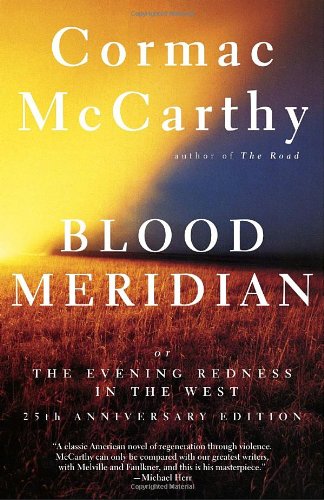
Book Review: Blood Meridian by Cormac McCarthy

Truly one of the most difficult novels I've ever read...

It has has been said that Shakespeare could never be just a single person as the sheer number of different words used in his works so vastly surpasses the vocabulary of even the most intelligent and verbose in society, it is just not possible to have that breadth of language housed in one brain.

Now I'm not always the sharpest tack in the room but I would say that I have an above average vocabulary and yet during numerous sections of this work I was sent scrambling for a dictionary half a dozen times or more PER PAGE.  Eventually it became such a task to review the language therein that I gave up and merely used the general context of the sentences to discern what was actually being said.  While frustrating, particularly for a novel written in the past thirty years (I would give some leeway to novels a century or greater ago as then we're talking about a vastly different lexicon from which the writers were pulling) it does not detract from the overall weight of the novel.  I wish McCarthy used more plain and direct language and didn't try to string a dozen or more metaphors together in an attempt to create a mood or describe a scene--it could have been a better and even more striking work for it (don't let anyone tell you this is a "perfect" work...its not.  But it is nearly as good a piece of fiction from the past 50 years that I've read).

The novel itself is based on some historical figures and events in the American Southwest during the late 1840s.  There are two primary characters here represented first by "the kid" whose violent upbringing eventually leads him to join up with the Glanton Gang.  The Glanton Gang itself was a real group of scalphunters lead by John Joel Glanton who was hired initially to exterminate a band of Apaches (bringing back their scalps as evidence) but turned rapidly to killing and scalping virtually everyone in their path in order to drive their income.  The second primary character is "the Judge" who is a character without much of a background but still fully formed.

Judge Holden becomes the driving force and most interesting part of the novel--is he the devil?  is he "the kid"'s alternate personality? what is he after?  why is he hairless?  is it he who keeps abducting and killing the children the group encounters?  McCarthy never gives the reader the answer but certainly provides enough detail for you to make your own conclusions.  The Judge has been rated by some as one of the most memorable characters in literature and I would agree.  While I may forget some of the details of the plot of this book moving forward or how the kid got involved in the first place, once you read Blood Meridian you will never, ever forget the Judge and will constantly circle back to him when you encounter antagonists in other works.

Blood Meridian is certainly not going to be for everyone.  Beyond the difficult language and complete lack of punctuation outside of sentence ending periods, McCarthy infuses the book with more violence than any novel I have ever read.  If you've seen No Country for Old Men or The Road then you may have a sense of McCarthy's violence as these are both based upon his prior works.  Even still, both of these films pale in comparison to the violence contained here.  Ridley Scott (who directed the recent film, The Counselor which was a McCarthy screenplay) has said that if he directed a film version of Blood Meridian that it would be rated NC-17 at the least and may not be filmable at all.  I tend to agree with him as the amount of blood and gore present is beyond what I have ever read before.  Not that it is unrealistic...on the contrary, it is probably VERY realistic given what we are dealing with.  The crushing of a baby's skull, the sodomizing of a injured opponent, the mutilation of a dead body, the scalping of a live body, and on and on and on...its not fun stuff...but if you turn to ask yourself "Is this real?" and you find yourself answering that yes, things likely were (and even more frighteningly, still are) this way.  It is stomach churningly brutal in its depictions.  And no one gets off looking good here.  The Americans, the Mexicans, the Indians, everyone here is capable of such levels of depravity and violence you "think" you are reading of a different world.  An example of such a depiction is here:

When Glanton and his chiefs swung back through the village people were running out under the horses' hooves and the horses were plunging and some of the men were moving on foot among the huts with torches and dragging the victims out, slathered and dripping with blood, hacking at the dying and decapitating those who knelt for mercy.  There were in camp a number of Mexican slaves and these ran forth calling out in spanish and were brained or shot and one of the Delawares emerged from the smoke with a naked infant dangling in each hand and squatted at a ring of midden stones and swung them by the heels each in turn and bashed their heads against the stones so that the brains burst forth through the fontanel in a bloody spew and humans on fire came shrieking forth like berserkers and the riders hacked them down with their enormous knives and a young woman ran up and embraced the bloodied forefeet of Glanton's warhorse.

Yup, that's what you're in for on a consistent basis.  That and more, over and over.  But that's partly what McCarthy and the Judge are getting at...that humanity has been, is and always will be a violent, ugly, brutal species and those who pretend otherwise are not "true dancers".  Whether that is true or not isn't the point, instead McCarthy is showing us what is often at the human core--what is at your and my core if we're honest and what we'll pass on to the next generation.  In fact McCarthy, in perhaps his most direct message to the reader begins the work with three epigraphs one of which is the following:
Clark, who led last year’s expedition to the Afar region of northern Ethiopia, and UC Berkeley colleague Tim D. White, also said that a re-examination of a 300,000-year-old fossil skull found in the same region earlier shows evidence of having been scalped 

This quotation taken from the Yuma Daily Sun in the early 1900s regarding the discovery of an early hominid skull in Africa that displayed signs of having been scalped itself.  Violence and war of the most horrific sorts has been with us, literally, since the beginning of time.  If you can take it, read this book, it will stay with you till the Judge comes to take you as well.
Sunday, February 23, 2014

Book Review: Kitchen Confidential

I first came to know Anthony Bourdain via TV, not via his books or his cooking and was drawn in by his straightforward manner and absolutely brutal honesty (whether right or wrong) about everything he encounters.  Perhaps some of it is for show at this point, I don't know, but his writing seems to predate his fame and thus I'm tempted to believe more than less of it.

Personally I don't care a ton about his opinions on food, I don't know a demi-glace from a duck confit and foie-gras and escargo sound downright nasty to me, regardless of how I'm told it tastes.  That said, I'm more interested in his travels and social experiences with others.  He has a way of describing his interactions that is brash and bracing.

He covers his rich boy upbringing, his time spent in Provincetown, MA as a cook there, and his time bouncing around various NYC establishments.  Bourdain doesn't discard his own shortcomings covering his drinking, drug use, womanizing, and overall loutish behavior.

Because he is honest with his readers about his own behavior, you believe him when he details the reasons behind the success or failure of a restaurant or an assessment of what makes a good chef or crew member.  It is here, with his assessment of himself and others that the true value of the book is found.  Bourdain might be an unrepentant smoker, drinker and former coke/heroin addict and current pot enthusiast...but he does have a code, valuing truth, honesty and simplicity--you could do worse.

I wouldn't choose to live my life like he has his, and I won't every be a "foodie" but I respect the vigor and courage with which Bourdain has lived his life while valuing his opinion on life, food, travel and politics simply because you know its going to be pure and unfiltered, which can be a rare thing.

The book is likely of much more value to those who know the chefs and cuisines Bourdain references but even to the lay reader there are laughs, fun and insights to be had and you can't ask for too much than that--a perfect work to accompany one on a trip, at the beach or any other time you want some quick, not completely mindless entertainment.

Thursday, January 30, 2014

Book Review: The Moon is a Harsh Mistress

My goodness...

I have yet to consume any Ayn Rand but I would imagine that Heinlein's The Moon is a Harsh Mistress has got to go up there with Rand in terms of solid Libertarian manifestos.

"I am free, no matter what rules surround me. If I find them tolerable, I tolerate them; if I find them too obnoxious, I break them. I am free because I know that I alone am morally responsible for everything I do."

and

"I beg of you — do not resort to compulsory taxation. There is no worse tyranny than to force a man to pay for what he does not want merely because you think it would be good for him."

These are just two of the numerous quotes from the novel that truly resonate with me and I would think with many of the libertarians and Silicon Valley inhabitants among us.

The novel itself is, in theory, science fiction, as it takes place primarily on the Moon and in the future (such as it was imagined when Heinlein wrote the work in the mid '60s).  Heinlein, like a proper great sci-fi author has a wonderfully imagined world of a penal colony on the Moon where the Earth sends many of its undesirables (not just pure criminals) to work as a compulsory labor force producing food for the starving masses back on the homeworld.  You have underground "warrens" where people live, a shortage of women driving all sorts of varied family structures, a mish mash of racial and religious backgrounds, a "self aware" computer, rock throwing rail guns, a global Lunar Authority, etc.  The novel is a futurist's thesis writ large.

Which isn't to say that this world is perfect--the participants are still tied to physical lines of communication--land lines for goodness sake!  But Heinlein can be forgiven for smaller items like this.  His overall call to arms for a rational anarchist revolution is an idea that grows with value each day.  A society with no laws or rules besides ones own morals may be a libertarian fantasy but that's not to say its not something to strive for.

While the main character of the novel is Manuel Garcia O'Kelly-Davis who speaks to the reader in a Russian like patois it is Professor Bernardo de la Paz who gives the novel its motion and inspiration.  la Paz is the theoretician and rational anarchist behind the Moon's revolution against Earth and it is he who drives the ideas Heinlein is directing to the reader. While I'm certainly not one to subscribe to all the ideas herein (and as this is a novel made to both entertain and to challenge it is NOT a political diatribe) the book does present a persuasive argument for revolution against authoritarian regimes as well as the subversive methods by which one might begin such an enterprise.  As with the best sci-fi novels, The Moon is a Harsh Mistress is both an excellent critique of our modern world and an entertaining supposition on where we might be heading.  Well worth the read, it should really get your hamster spinning.

Monday, December 30, 2013

Book Review: The Razor's Edge by W. Somerset Maugham

Picking up this book from a recommendation on the "War on the Rocks" website was an excellent choice. I had head Maugham's name before but never read any of his works. I now will likely read a number more.

The Razor's Edge straddles the periods of the worlds of English literature between say Hemingway and Fitzgerald and that of say Kerouac and Ginsberg. Here, published in 1944, some 13 years prior to the printing of On the Road we have a book covering the search for individual enlightenment involving Eastern philosophies attained via a visit to India by the protagonist. Additionally we have frank discussions of sex, homosexuality, drug and alcohol addictions, religion, social castes, rampant materialism and the choice to "drop out" of societal norms. To say that Maugham was ahead of his time is an understatement.

Leaning back on themes more prevelant in Hemingway and Fitzgerald however, The Razor's Edge concerns a WWI aviator who is traumitized sufficently by his experiences that he comes home to reject all the comforts afforded him as a well to do member of Chicago society. He wants nothing of the cushy investment job offered to him, nor anything of the beautiful but material/society driven woman he had been betrothed to. Instead he wants to "loaf" meaning to search out a greater meaning in life that than offered by modern American society.

Maugham's style is clear, direct and conversational. There are few minced words or sublteties and the book is eminently readable. The structure to the novel is also excellent as Maugham places himself within the story as an observer coming into and out of the lives of the protagonists over the course of many years. The reader observes the rise, fall and self destruction of all involved and no one escapes with their "self" intact.

The weakest part of the work comes when the lead character--Larry Darrell, sits with Maugham and explains just what it is he has found upon his long stay in India. Larry's recounting of his time spent with a guru and learning to find his highest self through meditation and other Hindu practices comes off as a college freshman's dabblings in alternative religions and neither powerful nor explanatory in any satisfying manner. Western culture's coming interest in all things Eastern is forecast quite nicely here.

Outside of this one chapter however the book is quite powerful and riveting. The characters are real in that, to use a cliche, you feel as if you could almost reach out and touch them--likely because we all know people in our lives quite similar to them. If you can get through this work without a twinge of sadness for the tragedies and intellectual searchings befalling those who exist only on the printed page herein, you have a harder heart than I. I always view books that can stir my emotions and my thoughts in the best of regards--and that's what The Razor's Edge has done for me.

Thursday, December 26, 2013

Book Review: The First War of Physics--The Secret History of the Atom Bomb 1939-1949

Been a bit since I've posted anything--holiday season and all so we'll start off slow.

The above titled book by Jim Baggot is no lightweight coming in at nearly 600 pages. Baggot has generally kept the scope of his writing to Physics related topics such as the Higgs Boson, Quantum Theory and other modern topics.  TFWOP reaches back some 70+ years to cover the creation of the first atomic and hydrogen bombs.

The scientists that take part in this story read like a laundry list of Nobel Prize winners including Einstein, Fermi, Bohr, Teller, Heisenberg, Feynman, Oppenheimer, etc., etc. and the book covers them all in one respect or another.  If you are looking for an in depth examination of the Manhattan Project or of the Russian intelligence program that stole many of the US developed "secrets" or of the military history behind the use of these weapons, or a detailed scientific treatise on the physics behind the bombs--that's not what this work is.

What Baggot achieves here is a broad overview of the worldwide effort towards the development and use of atomic weapons during this period.  You get the Germans who were off to an early start but fell behind for numerous (and readily debatable) reasons, you get the Russians playing catch-up with the Americans via their communist sympathizers in the States and England, you get England who had a well developed program but without the necessary resources and you get the US who is the beneficiary of massive industrial scale, and a combination of its own scientists and the flight of brilliant European theoreticians due to Hitler's policies.

In essence you get a primer on all four of the major atomic efforts at this time and a look at why each one succeeded or failed and their influence, either direct or indirect on one another.  There is enough here to satisfy the "spy enthusiast" involving secret missions of sabotage and assassination as well as the amateur physics buff with "lensing" discussions, stories behind the discovery of the various elements and their isotopes and the trial and error development of how to achieve a supercritical mass.

I feel vastly more knowledgeable about the events that went on to largely shape our modern world over the following half century or more than I was before reading this book.  Most impressive to me is that all of the work attributed to these scientists was done wholly without the benefit of modern computing power.  All theories, formulas, calculations, experiments, monitoring, and measurements were done with what we would view as archaic devices and methods, doing things by hand that we would task to an electronic device today.  That they were able to develop these devices in such an environment is astonishing--and this book should leave the reader with the appropriate sense of awe over just what the force of the human mind can accomplish.


Sunday, March 24, 2013

Book Review: The Big Show

The full title here is actually The Big Show: The Greatest Pilot's Story of World War II by Pierre Clostermann.

I still haven't figured out whether this title means the "greatest PILOT'S story" or the "greatest pilot's STORY" though I'm hoping its supposed to be the latter and not the former as it would be incredibly presumptuous of Clostermann to call himself the greatest pilot ever...

Still, the novel itself is a solid read and a good recap of the airwar in Europe.  Clostermann was certainly worthy of admiration as he volunteered for the free French Air Force and served in the RAF and the FFAF from '42 through the end of the war.  The book itself is drawn from the daily diary Clostermann kept throughout that time.

The book keeps some of the repetitive nature of a day to day diary but recounts enough of the major events from a fresh perspective to keep things quite interesting.  Clostermann pilots a Spitfire in Southern England, is shipped off to the near arctic North, conducts operations prepping for the Normandy invasion, becomes one of the first Frenchmen to land back in France and helps hasten the Nazi downfall through his destruction of numerous trainyards, airfields and supply transports.

While not the biggest ace of the war, Clostermann was no slouch shooting down an estimated 18 air to air victories (though this most recent, more precise estimate is a substantial decline from the 33 in the official record and cited by the author and amusing given the author's frequent issue with American aviators' overestimate of their tallies).  Included under his claimed victories are those over numerous FW-190s, ME-109s as well as some early jets such as the ME-262s and Arado 234s.

The anecdotes contained in this work are what makes it most worth reading.  Clostermann doesn't pull any punches in describing both his adversaries and allies and carries a particular distaste for Americans it seems going well beyond the "overpaid, oversexed and over-here" cliche that was common at that time.

His descriptions of air to air combat are the highlight.  This is true "knights of the air" stuff with Clostermann strapping himself in to a machine always seemingly on the edge of control, heading into a joust with an equally aristocratic knight.  As his friends fall one by one you can hear the stress tearing him to pieces and feel the associated affects on his health.

DeGaulle, Spitfires, Tempests, Churchill, Americans, Germans, English, free French, V1s, wartime atrocities, suicidal missions, drunken escapades, carousing for women, near death landings, bailouts, happanstance encounters, courage, failure, cowardice, stupidity--all the things that make war...war, are here.


Clostermann would go on in later life to fly ground attack missions the Algerian War, be a major critic of the Falkland War in the early 80's and later the first Gulf War but whatever his later views his work here was regarded by William Faulkner as the finest book of aviation to come out of WWII.  I haven't read enough to know whether this is true or not, but I'm betting The Big Show isn't a bad place to start either.

Saturday, February 2, 2013

Book Review: Pennant Race

This book is essentially a companion work to The Long Season which Brosnan had written a few years prior.  The earlier work chronicled Brosnan's season that began with the Cardinals and ended with the Reds.  This book takes place entirely with the Reds during a season in which they would win the National League pennant and eventually lose to the Yankees in the World Series.

The Long Season is generally regarded as one of, if not the, best account of day to day baseball ever written. After its success and positive reviews, Brosnan, a pitcher nicknamed "the professor" due to his intellect, glasses and bookish habits, comes back here with another account of another season.  The format is familiar and similar to the earlier work with Brosnan recounting numerous day to day conversations between himself and other players and his views of the occurrences both on and off the field.

While not boring, the first 2/3 of Pennant Race doesn't hold enough of the readers interest to make it comparable to the prior work.  The book moves along with recap after recap of game after game so that they all tend to blend together in the reader's mind.  Nothing much makes an impact as there isn't much of consequence going on.

That changes in the last third of the book as the Reds come down the stretch with the Dodgers, vying for the pennant.  At this point the book begins feeling like there is a direction to the narrative and a purpose to each day's actions.  With this returns the reader's interest. Brosnan's anecdotes of shoddy umpiring, hungover players, players watching the stands for attractive women and the failings of himself and other players finally have bite.  The last few chapters, during which the Reds and Dodgers are locked in a tight battle for a chance to face the Yankees are excellent and the stress and pressure is well presented.

As always Brosnan presents a good deal of political, racial and cultural commentary--from Kruschev to the growing immunity of feeling to the word "nigger" by the black baseball players around him, his recap of the 1961 baseball season captures not only the sporting season but also that particular period in American culture.  This isn't quite the work that The Long Season was...but its not exactly a sophomore slump either.